ODosta Inc. Create Your Own Tech World

In today’s digital world, software plays a critical role in almost every aspect of business and daily life, from mobile apps and websites to enterprise systems and cloud platforms. As software becomes more complex and user expectations rise, ensuring quality, reliability, and security is no longer optional. This is where software testing comes in. Despite its importance, software testing is often misunderstood, underestimated, or seen as a purely technical afterthought. In reality, testing is a structured, strategic process that helps teams deliver stable, user-friendly, and high-performing software. This blog post aims to demystify the software testing process by explaining what it is, why it matters, how it works, and the different stages involved.
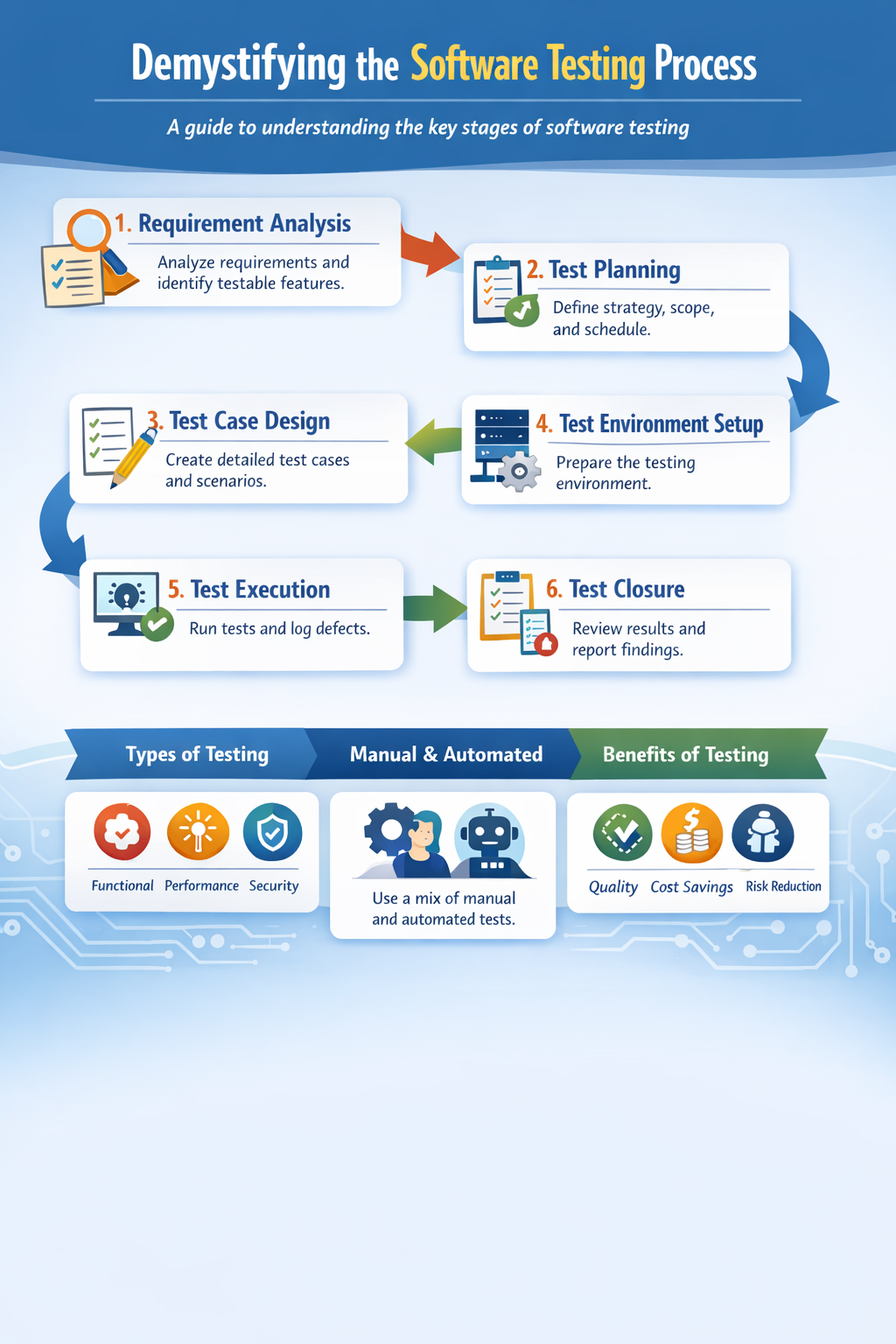
What Is Software Testing?
Software testing is the process of evaluating a software application or system to identify defects, verify functionality, and ensure it meets specified requirements. The goal is not just to find bugs, but to validate that the software works as intended, performs efficiently, and provides a positive user experience.
Testing answers critical questions such as:
-
Does the software do what it is supposed to do?
-
Does it behave correctly under different conditions?
-
Is it secure, fast, and user-friendly?
-
Can it scale as users and data grow?
By addressing these questions early and continuously, testing reduces risks, saves costs, and improves overall product quality.
Why Software Testing Is Important
Software failures can have serious consequences, including financial loss, reputational damage, security breaches, and user frustration. Effective testing helps prevent these issues by identifying problems before the software reaches end users.
Key benefits of software testing include:
-
Improved Quality and Reliability
Testing ensures that features work correctly and consistently across different environments and use cases. -
Cost Savings
Fixing bugs early in development is significantly cheaper than fixing them after release. -
Enhanced User Experience
Well-tested software is more intuitive, stable, and enjoyable to use. -
Security Assurance
Testing helps uncover vulnerabilities that could expose sensitive data or systems to attacks. -
Compliance and Standards
Many industries require software to meet regulatory or quality standards, which testing helps validate.
Types of Software Testing
Software testing is not a single activity but a collection of different testing types, each serving a specific purpose.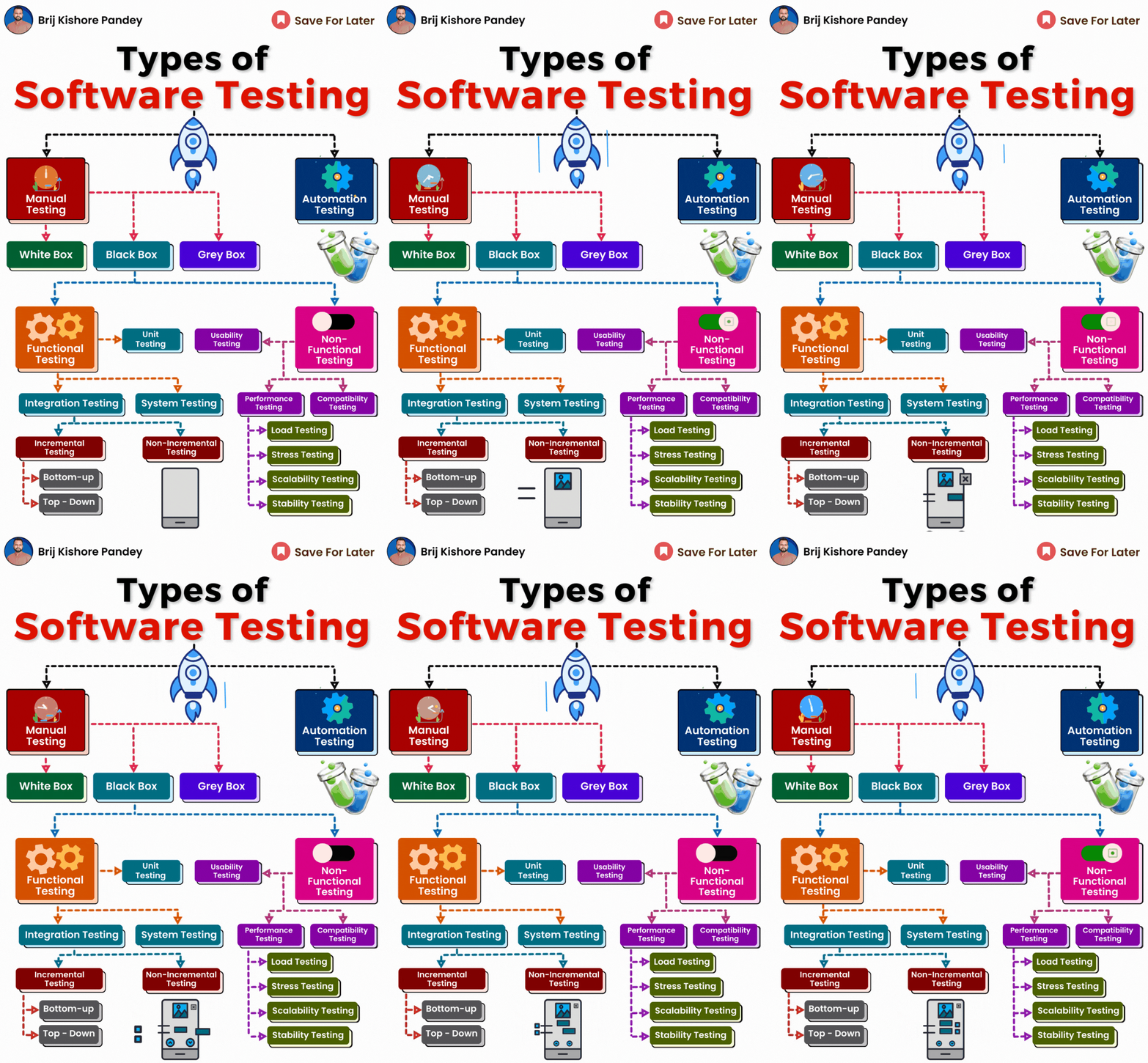
Functional Testing
Functional testing verifies that the software functions according to requirements.
Common types include:
-
Unit Testing
-
Integration Testing
-
System Testing
-
Acceptance Testing
Non-Functional Testing
Non-functional testing focuses on how the system performs rather than what it does.
Examples include:
-
Performance Testing
-
Load and Stress Testing
-
Usability Testing
-
Security Testing
-
Compatibility Testing
Manual vs. Automated Testing
-
Manual Testing involves human testers executing test cases and exploring the application.
-
Automated Testing uses tools and scripts to execute tests quickly and repeatedly.
Most modern projects use a combination of both to balance speed, accuracy, and flexibility.
Common Myths About Software Testing
Despite its maturity, several myths still surround software testing:
-
“Testing is only about finding bugs.”
In reality, testing is about quality assurance and risk reduction. -
“Testing happens after development.”
Modern practices emphasize continuous testing throughout the development lifecycle. -
“Automation can test everything.”
Automation complements manual testing but cannot replace it entirely. -
“Testing slows down development.”
Proper testing actually speeds up delivery by reducing rework and failures.
Best Practices for an Effective Testing Process
To get the most value from software testing, organizations should follow best practices such as:
-
Involving testers early in the project
-
Maintaining clear and updated documentation
-
Prioritizing tests based on risk
-
Using a balanced mix of manual and automated testing
-
Encouraging collaboration between developers, testers, and stakeholders
-
Continuously improving testing processes based on feedback
Real-World Examples in the Software Testing Process
Understanding theory is important, but real-world examples make the software testing process clearer and more relatable. Below are practical examples that show how testing works in everyday software projects.
1. Requirement Analysis – Real-World Example
Example: E-Commerce Website Checkout
Imagine a company developing an e-commerce website. One requirement states:
“Users must be able to complete purchases using credit cards and digital wallets.”
During requirement analysis, testers identify testable points such as:
-
What happens if payment fails?
-
Is the total amount calculated correctly with taxes and discounts?
-
Are error messages clear to the user?
By reviewing requirements early, testers may discover missing details—such as refund handling or payment timeout behavior—before development even begins, preventing costly redesign later.
2. Test Planning – Real-World Example
Example: Banking Mobile Application
A bank launching a new mobile banking app creates a detailed test plan that includes:
-
Security testing for login and transactions
-
Performance testing during peak usage hours
-
Compatibility testing across Android and iOS devices
The test plan ensures that sensitive financial data is protected and that the app remains stable when thousands of users log in simultaneously especially during salary deposit days.
3. Test Case Design – Real-World Example
Example: Ride-Sharing App
For a ride-sharing application, testers design test cases such as:
-
Booking a ride with valid pickup and drop locations
-
Attempting to book a ride with GPS disabled
-
Canceling a ride after driver assignment
-
Applying promo codes correctly
These test cases help ensure that both typical and edge-case user behaviors are handled smoothly, reducing customer complaints after launch.
4. Test Environment Setup – Real-World Example
Example: Healthcare Management System
A hospital uses a healthcare management system that must comply with strict data protection rules. Testers create a test environment that:
-
Mirrors production servers
-
Uses masked patient data
-
Includes realistic user roles (doctors, nurses, administrators)
This setup ensures accurate testing while protecting sensitive patient information and meeting compliance requirements.
5. Test Execution – Real-World Example
Example: Online Learning Platform
An online education platform releases a new feature for live video classes. During test execution:
-
Testers verify video streaming quality
-
Simulate multiple students joining simultaneously
-
Test chat, screen sharing, and recording features
When a bug causes sessions to crash after 30 minutes, testers log the issue, developers fix it, and regression testing ensures older features still work correctly.
6. Test Closure – Real-World Example
Example: Enterprise HR Software
After testing an HR payroll system, the team prepares a test summary report that shows:
-
95% test case pass rate
-
All critical payroll calculation bugs resolved
-
Minor UI issues deferred to the next release
This report helps stakeholders confidently approve the software for deployment before payroll processing begins.
Functional Testing – Real-World Example
Example: Food Delivery App
Functional testing ensures that:
-
Users can search restaurants
-
Orders are placed correctly
-
Payments are processed
-
Delivery tracking updates in real time
If a user orders food but the order does not reach the restaurant, functional testing helps identify where the workflow failed.
Conclusion
Software testing is not a mysterious or optional step, it is a fundamental part of building reliable, secure, and user-friendly software. By understanding the testing process, its stages, and its value, teams can move beyond viewing testing as a bottleneck and instead see it as a strategic advantage.
Demystifying the software testing process helps organizations deliver better products, earn user trust, and remain competitive in an increasingly software-driven world. Whether you are a developer, tester, project manager, or business stakeholder, embracing a structured and thoughtful testing approach is essential for long-term success.